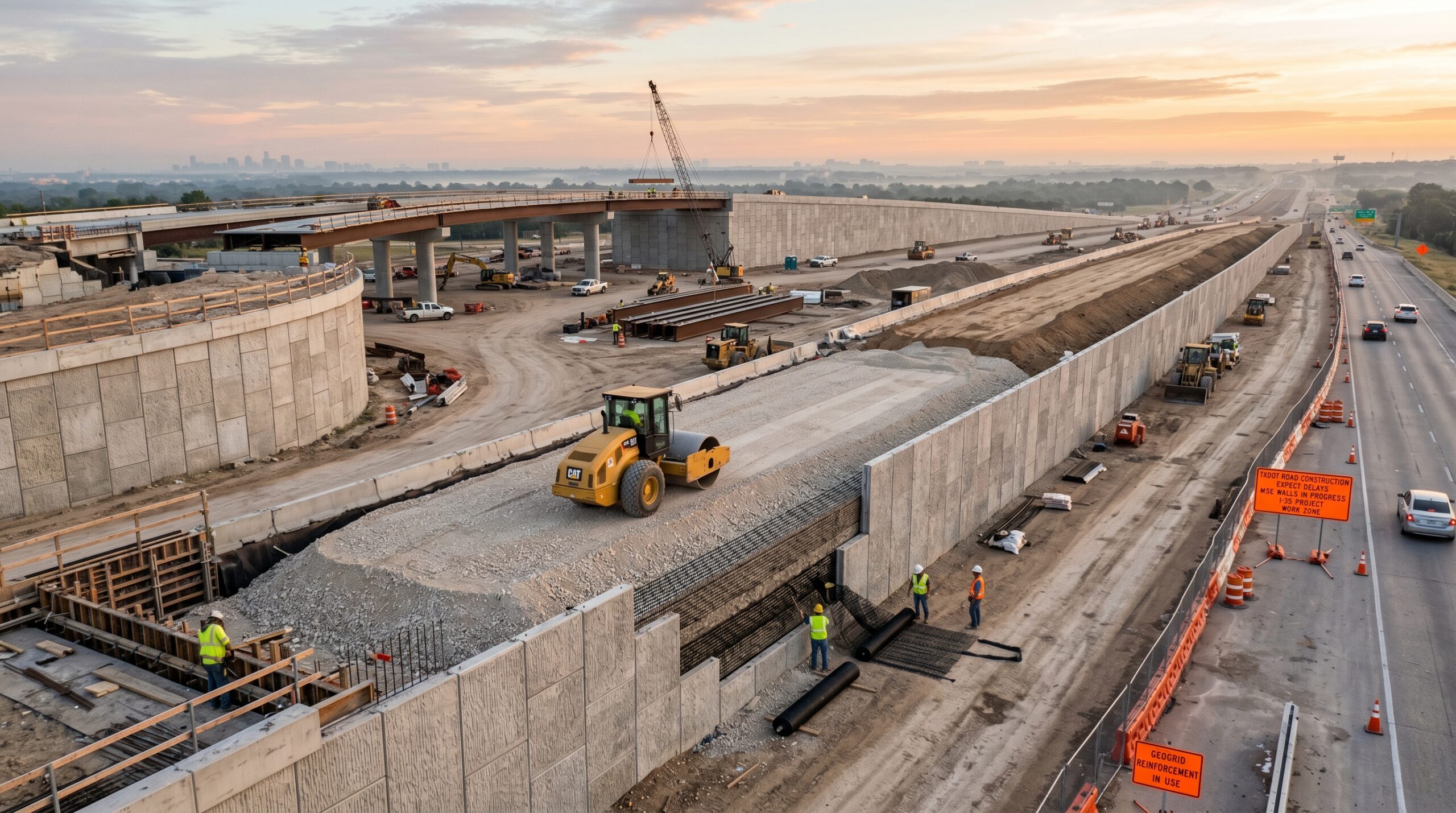
Texas highways are constantly expanding to support rapid population growth, freight movement, and commercial development. Projects along I-35, I-45, Loop 1604, and SH 130 often require retaining walls, elevated ramps, and stabilized embankments that can handle heavy traffic loads and shifting soil conditions. Behind many of these structures is one critical component: MSE backfill in Texas highway construction projects.
MSE, or mechanically stabilized earth, systems rely on engineered backfill materials to create stable reinforced soil structures. Choosing the wrong material can lead to drainage problems, settlement issues, and long-term structural failure. That’s why contractors and engineers pay close attention to the type of aggregate and structural fill used behind retaining walls and roadway embankments.
As highway infrastructure development continues across Texas, demand for high-performance MSE backfill materials Texas contractors can source efficiently continues growing.
Why Material Selection Matters in MSE Highway Systems
MSE retaining systems are designed to distribute loads through reinforced layers of compacted soil and aggregate. While reinforcement grids and wall panels are important, the backfill itself plays a major role in long-term performance.
Poor-quality fill can trap moisture, weaken compaction, and increase pressure behind retaining walls.
The Role of Engineered Structural Fill
Unlike regular excavation dirt, mechanically stabilized earth backfill must meet specific engineering standards for:
- Drainage performance
- Load-bearing strength
- Compaction consistency
- Soil stability
This is especially important on Texas highway projects where retaining systems support high traffic volumes and elevated roadway sections.
The Federal Highway Administration explains that properly selected backfill materials improve reinforced soil system performance and reduce long-term maintenance risks.
Why Texas Soil Conditions Create Challenges
Texas contractors deal with a wide range of soil conditions depending on the region.
For example:
- Houston projects often face moisture-heavy clay soils
- North Texas projects encounter expansive soils
- Central Texas construction frequently involves rocky terrain and erosion concerns
Because of these conditions, contractors rely on engineered retaining wall backfill Texas projects require instead of untreated site dirt.
Best Materials Used for MSE Backfill in Texas Highway Construction Projects
Not every aggregate works well in reinforced soil systems. Contractors and engineers typically choose materials that balance strength, drainage, and availability.
Crushed Limestone Aggregates
Crushed limestone is one of the most common MSE backfill materials Texas highway contractors use.
It provides:
- Strong compaction characteristics
- Good drainage performance
- Reliable structural stability
This material is widely used in highway retaining systems near Dallas–Fort Worth and San Antonio because limestone quarries are readily available across Texas.
Crushed limestone also performs well under heavy traffic loads, making it suitable for bridge approaches and embankment stabilization.
Granular Select Fill
Granular select fill is another preferred option for highway construction backfill materials.
Compared to natural excavation soil, select fill offers:
- Better moisture control
- Lower plasticity
- Improved compaction
Projects along I-35 and SH 288 often use select fill for reinforced slopes and retaining wall systems where consistent soil performance is critical.
Washed Gravel and Drainage Aggregates
Drainage is one of the most important factors in retaining wall performance. Washed gravel aggregates help move water away from reinforced soil systems, reducing hydrostatic pressure behind wall structures.
This becomes especially important in areas prone to heavy rainfall and flooding, including Houston and Gulf Coast highway corridors.
Proper drainage aggregates also help improve long-term erosion control around retaining walls and embankments.
How Contractors Choose the Right MSE Backfill Material
Material selection isn’t based on price alone. Contractors must balance engineering requirements, project timelines, hauling logistics, and supplier availability.
Meeting Engineering and DOT Specifications
Most highway projects require backfill materials that meet strict geotechnical and transportation standards.
The Texas Department of Transportation outlines material requirements for reinforced soil structures used in roadway construction.
Engineers typically evaluate:
- Gradation
- Moisture content
- Friction angle
- Compaction performance
- Drainage capability
This ensures the backfill supports long-term retaining wall stability.
Balancing Material Availability and Delivery Efficiency
On large infrastructure projects, delays in sourcing material can impact grading schedules and wall installation timelines.
Contractors increasingly rely on digital sourcing systems to improve visibility into available bulk backfill aggregates Texas suppliers can provide.
BorrowPit helps contractors connect with suppliers offering aggregates, structural fill, and construction materials through both marketplace listings and direct brokering support. Some contractors prefer to work directly with brokers for quotes and sourcing coordination, while others use listing-based advertising to connect with buyers and suppliers independently.
BorrowPit explains its sourcing model further on its About page, where the platform focuses on improving material visibility and construction logistics efficiency.
Where MSE Backfill Is Commonly Used in Texas Highway Projects
The demand for MSE backfill in Texas highway construction projects continues growing because retaining systems are now used across multiple types of transportation infrastructure.
Bridge Approaches and Elevated Ramps
MSE retaining walls are commonly installed near bridge approaches because they provide stable support for elevated roadway transitions.
Projects along:
- I-10 in Houston
- I-635 in Dallas
- Loop 410 in San Antonio
frequently use reinforced soil systems for ramp construction and grade separation.
Highway Expansion and Embankment Stabilization
As Texas highways widen to accommodate traffic growth, contractors often need retaining walls to stabilize embankments and maximize roadway space.
This is especially common in urban areas where space constraints make vertical retaining systems more practical than large sloped embankments.
Flood and Erosion Control Infrastructure
Many highway corridors in Texas also require erosion protection and drainage stabilization.
Properly selected engineered fill Texas contractors use can improve water movement while reducing long-term maintenance problems caused by soil erosion.
The Growing Role of Smarter Material Coordination
Material sourcing has become increasingly important as highway projects grow larger and more logistics-driven.
Using Digital Platforms for Faster Sourcing
Contractors no longer rely only on local phone networks to source backfill materials. Digital construction marketplaces now help improve procurement planning and supplier visibility.
BorrowPit supports both:
- Direct material brokering for contractors seeking sourcing assistance
- Marketplace advertising where suppliers can list material directly for buyers
This flexibility helps streamline sourcing for large infrastructure projects requiring specialized backfill materials.
For sourcing coordination and project inquiries, contractors can connect through BorrowPit’s contact page.
Final Thoughts
Choosing the right MSE backfill in Texas highway construction projects is critical for long-term retaining wall performance, roadway stability, and drainage control. Contractors across Texas increasingly rely on engineered aggregates and structural fill materials that meet strict geotechnical standards while supporting efficient project delivery.
From crushed limestone to granular select fill, the right material improves compaction, reduces erosion risks, and strengthens reinforced soil systems used throughout Texas infrastructure projects.
For contractors looking to improve sourcing efficiency, opportunities are available to search listings near you for available aggregate and fill materials or list your material to connect with active buyers and suppliers across Texas.
FAQs
What is MSE backfill used for in highway construction?
MSE backfill is used behind retaining walls and reinforced soil systems to improve stability and drainage.
What materials are best for MSE backfill?
Crushed limestone, select granular fill, and washed gravel are commonly used.
Why is drainage important in MSE retaining walls?
Proper drainage reduces hydrostatic pressure and helps prevent retaining wall failure.
Does Texas DOT regulate MSE backfill materials?
Yes, highway projects must meet engineering and transportation material specifications.
Where are MSE retaining systems commonly used?
They are used on bridge approaches, highway ramps, embankments, and erosion control projects.