Municipal utility contractors, civil engineers, and public works project managers across Texas operate under strict regulatory oversight when executing public infrastructure builds. Whether backfilling deep sewer mains in Houston or constructing containment dikes for a regional wastewater treatment plant in Dallas, meeting fill dirt specs for wastewater projects determines whether earthwork passes municipal field inspection or faces complete work rejection. Public infrastructure earthwork requires rigorous quality control because subgrade failures compromise public health, environmental safety, and long-term taxpayer investment across public works contracts.
Unlike private commercial site grading where minor subgrade movement can often be remediated during pavement prep, public utility installations demand far tighter soil parameters. Understanding fill dirt specs for wastewater projects prevents untreated liquid seepage, utility line shearing, trench settlement, and costly public works rejections.
Why Municipal Projects Require Tighter Specs Than Commercial Sites
Public infrastructure specifications enforced by municipal utility districts, river authorities, and city public works departments demand unyielding quality control for every load of imported soil delivered to the project.
Wastewater treatment lagoons, storm overflow basins, and deep sanitary sewer trenches must prevent untreated liquid effluent from leaching into local groundwater aquifers. Meeting strict fill dirt specs for wastewater projects guarantees low hydraulic conductivity, forming an impermeable hydraulic barrier around utility pipes, holding basins, and treatment structures.
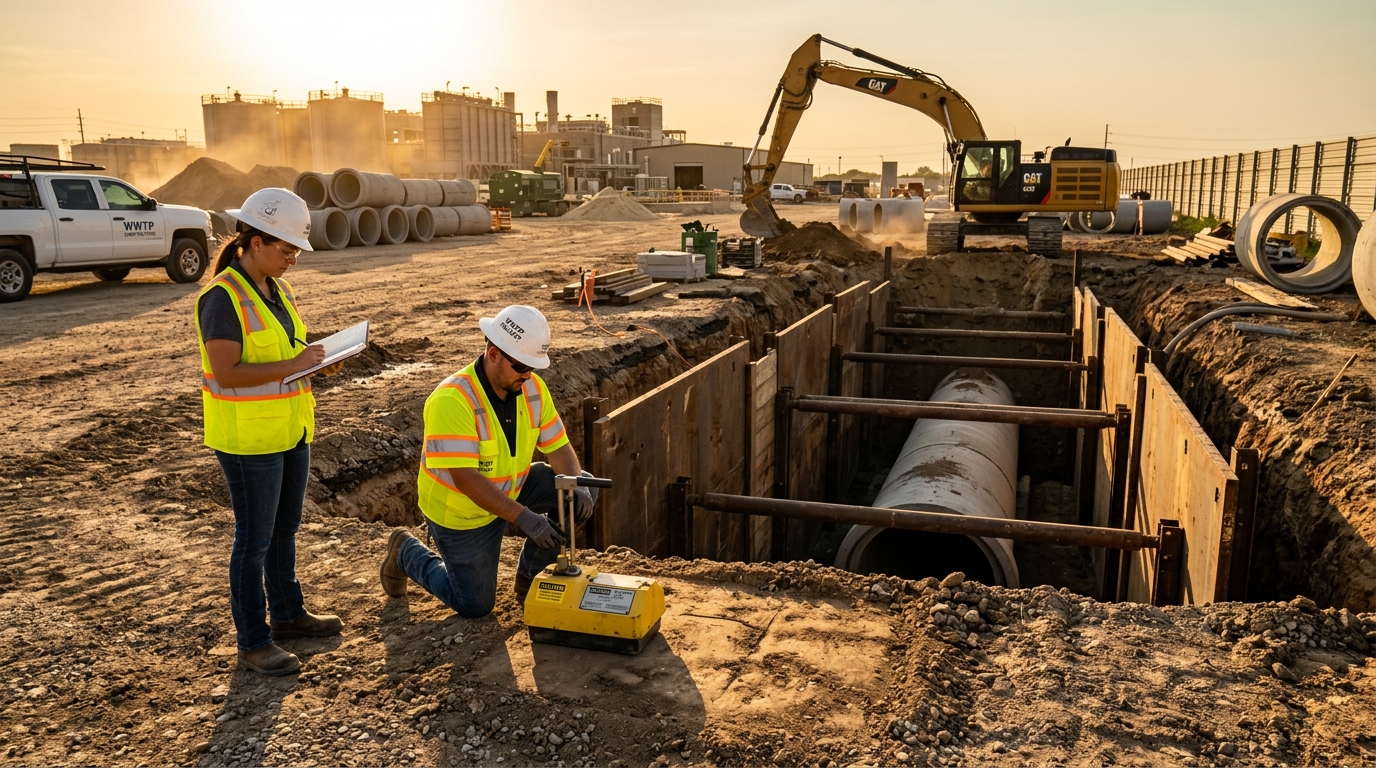
Underground utility mains, pre-cast concrete manholes, and deep lift station vaults undergo continuous earth pressure, hydraulic uplift, and traffic vibrations. If trench backfill contains organic debris or high-expansion CH clay, seasonal soil movement can shear underground pipes, crack concrete vault walls, and damage municipal infrastructure assets.
Common Soil Classifications Required: CL, CL-ML, and A-6
Geotechnical specifications governing public infrastructure rely on standardized testing protocols under ASTM D2487 and AASHTO M145:
CL Soil Classification (Lean Clay)
Lean clay is a low to medium plasticity soil featuring a Liquid Limit under 50 and a Plasticity Index strictly controlled between 10 and 20. CL soil compacts into a dense, low-permeability mass that provides ideal structural support without dangerous shrink-swell movement during dry or rainy seasons.
CL-ML Soil Classification (Silty Clay)
Silty clay blends offer excellent workability and low swell potential, making them popular for utility trench capping where rapid moisture adjustment is required during fast-paced municipal utility installations.
A-6 AASHTO Soil Classification
Commonly specified under Texas Department of Transportation Item 132 for embankment construction, A-6 soils contain fine-grained clay that provides reliable compaction density under heavy roller equipment across highway right-of-way zones.
Contractors must verify that fill dirt specs for wastewater projects meet these exact parameters before importing bulk yardage to job sites.
Role of the Geotechnical Engineer in Approving Material
The Engineer of Record and third-party testing agency evaluate every proposed soil source before dump trucks unload material on municipal job sites.
Compaction Density and Moisture Limits
Geotechnical engineers review lab compaction data under Standard Proctor Density (ASTM D698) or Modified Proctor (ASTM D1557), establishing the maximum dry density and optimum moisture window for field placement. Field technicians verify compaction using nuclear density gauge testing on every lift.
Chemical and Corrosive Property Analysis
Inspectors analyze soil chemistry to confirm organic content remains below 1 percent by dry weight. Furthermore, engineers test soluble sulfate and pH levels to ensure the soil will not chemically corrode concrete structures, ductile iron pipe walls, or underground electrical conduit.
What a Material Submittal Package Looks Like
Before site delivery begins, utility contractors prepare a formal engineering submittal package for municipal review and approval.
Core Testing Documentation Requirements
A complete submittal includes recent lab test sheets detailing Atterberg Limits (Liquid Limit, Plastic Limit, and Plasticity Index), Grain Size Sieve Analysis (ASTM C136 showing fines passing the No. 200 sieve), and a certified Moisture-Density Proctor Curve.
Understanding Laboratory Test Failures and Retesting Protocols
When a proposed pit soil fails initial Atterberg limits or sieve gradation tests, contractors must either identify a different pit stratum or source material from a separate pre-qualified borrow pit. Geotechnical engineers will not issue a conditional approval for non-compliant soil on municipal wastewater infrastructure due to the severe long-term environmental liabilities associated with liquid effluent containment.
Chain of Custody and Lab Certifications
Submittals must feature signed lab cover letters from accredited geotechnical testing facilities, identifying the exact pit location, excavation face, and stratum depth where soil samples were gathered.
Sourcing Approved Municipal Soil in Regional Texas Markets
Securing tested soil for public works requires working directly with pre-vetted borrow pits that maintain active lab testing records. Project managers who need compliant clay for utility trenches can locate qualified borrow pits through a construction material marketplace Texas platform like BorrowPit. Browsing material listings by location allows utility superintendents to search listings near them to verify pit soil test reports before placing purchase orders. Furthermore, contractors with excess certified cut dirt can list their excess material to connect with regional buyers, simplifying dirt logistics, eliminating haul delays, and keeping public works builds moving on schedule.
Conclusion
Meeting fill dirt specs for wastewater projects ensures municipal infrastructure remains structurally sound, water-tight, and compliant with environmental regulations. By partnering with tested borrow pits and submitting complete engineering packages weeks before mass excavation begins, utility contractors prevent costly job-site rejections and schedule delays. Sourcing verified soil through BorrowPit keeps municipal earthwork moving efficiently while protecting public infrastructure investments.
Frequently Asked Questions
What soil Plasticity Index is typically specified for wastewater trench backfill?
Municipal specifications typically require a Plasticity Index between 10 and 20 to ensure sufficient soil cohesion without excessive shrink-swell movement.
Why is high-plasticity CH clay rejected on wastewater projects?
High-plasticity CH clay expands significantly when wet and shrinks when dry, exerting high lateral soil pressure that can shear utility pipes and crack concrete structures.
What lab tests are required in a municipal soil submittal?
Submittal packages require Atterberg Limits (ASTM D4318), Grain Size Sieve Analysis (ASTM C136), Standard Proctor Compaction (ASTM D698), and organic content testing.
Who reviews and approves fill dirt submittals on public works jobs?
The lead Engineer of Record or municipal geotechnical consultant reviews and stamps soil submittals before excavation and material delivery begin.
What happens if field nuclear density tests fail on a utility trench lift?
Utility contractors can search verified borrow pit listings on BorrowPit to locate tested municipal clay and connect with certified suppliers across Texas.