When civil site contractors prepare heavy commercial parking pads, industrial laydown yards, or haul road subgrades, material costs for virgin quarried stone can rapidly stretch project budgets. Heavy dump truck freight charges combined with rising quarry prices force project managers to evaluate durable subbase alternatives. Specifying crushed concrete base provides civil contractors with an engineered recycled aggregate that matches or exceeds virgin crushed stone in structural shear strength while reducing material procurement expenses.
Made from recycled demolition concrete, slab cutoffs, and crushed pavement structures, recycled aggregate has become a primary material across civil earthwork and road construction. Understanding how crushed concrete base performs enables superintendents, paving contractors, and site developers to choose the right subbase material, lower project carbon footprints, and protect profit margins across commercial builds.
Defining Crushed Concrete Base and Recycled Aggregate Mechanics
Recycled subbase material is produced by crushing removed concrete structures, foundations, sidewalks, and pavements into specified particle gradations.
Raw concrete demolition waste is delivered to recycling yards where heavy jaw crushers, cone crushers, and magnetic separators process the material. Magnets pull out steel rebar and wire mesh, while industrial screens filter the rock into standardized gradations (typically 1.5-inch down to fine dust, commonly designated as Grade 1 or Grade 2 aggregate).
A distinct engineering advantage of crushed concrete base is its self-cementing capability. Un-hydrated cement particles remaining within the crushed concrete dust react with moisture during roller compaction. Over time, this chemical hydration re-binds aggregate particles together, creating a rigid structural matrix that hardens into a durable subbase layer.
Typical Applications Across Commercial Civil Projects
Engineers specify recycled aggregate across a wide variety of civil infrastructure and land development projects:
Commercial Parking Lots and Industrial Building Pads
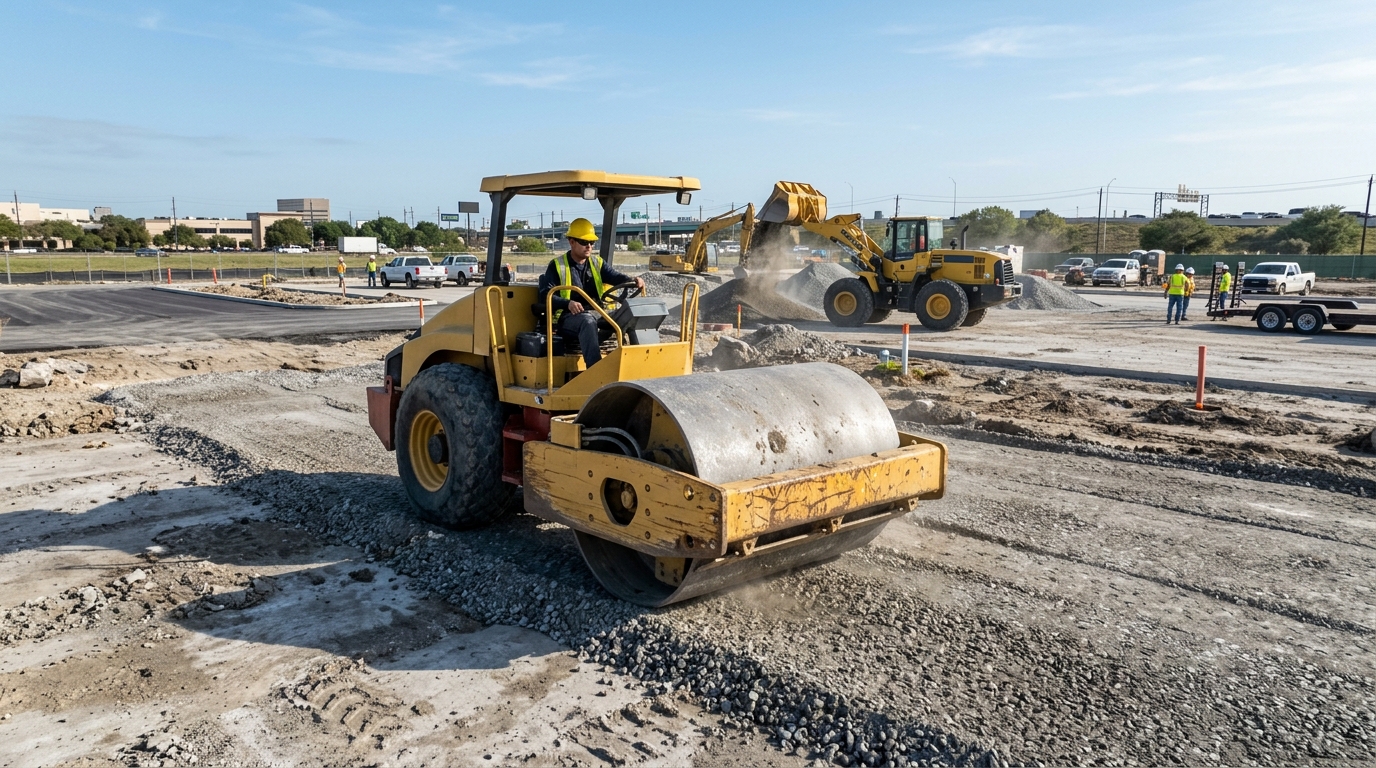
Placing a 6-inch to 12-inch lift of crushed concrete base beneath asphalt parking lots or warehouse slab pads provides high structural support. The inter-locking angular particles distribute wheel loads evenly across soft subgrades, preventing asphalt rutting and slab cracking.
Heavy Equipment Access Roads and Temporary Laydown Yards
On active job sites, heavy loaded dump trucks and trackhoes ruin wet clay access routes. Spreading recycled concrete aggregate over soft soil creates an immediate, weatherproof haul road that supports heavy equipment without rutting during rain events.
Driveway Subbases and Utility Trench Stabilization
Residential developers use recycled aggregate for driveway subbases, shoulder backing, and deep utility trench stabilization where high load capacity is required at a lower unit cost.
Subgrade Moisture Control and Proof Rolling Lifts
Before placing final base lifts, superintendents proof-roll subgrade soils with loaded tandem trucks. Applying recycled concrete fill over soft clay pockets stabilizes weak spots, allowing site crews to pass proof-rolling inspections without expensive chemical lime stabilization.
Performance and Cost Comparison: Crushed Concrete vs Virgin Flexbase
Comparing recycled aggregate to virgin limestone or crushed granite reveals distinct economic and mechanical advantages:
California Bearing Ratio (CBR) and Load Strength
According to technical research by the Federal Highway Administration, recycled concrete subbase material frequently demonstrates California Bearing Ratio (CBR) values ranging from 100 to 140 percent. This equals or exceeds the load strength of standard virgin limestone flexbase (which typically ranges from 80 to 100 CBR).
Moisture Sensitivity and Drainage Characteristics
Because crushed concrete contains angular, rough particle surfaces, it locks together tightly under roller compaction. However, recycled concrete material absorbs slightly more water than virgin limestone during initial moisture conditioning, requiring proper moisture control during field rolling.
Direct Material and Freight Cost Savings
Recycled aggregate generally costs 20 to 40 percent less per ton at the processing plant than virgin crushed limestone. In addition, because concrete recycling yards are often located closer to urban centers than rural rock quarries, haul truck freight costs are significantly reduced.
Environmental and LEED Benefits of Recycled Aggregates
Utilizing recycled concrete fits modern green building standards and municipal sustainability directives.
Diverting Heavy Demolition Waste from Landfills
Crushing old concrete structures diverts thousands of tons of bulky waste from municipal landfills, preserving landfill capacity while conserving virgin rock resources in natural quarries.
Earning Sustainable Construction Credits on Commercial Builds
Using crushed concrete base contributes to LEED (Leadership in Energy and Environmental Design) certification credits under the Materials and Resources category. Documenting recycled content percentages helps developers achieve green building ratings on major commercial developments.
Streamlining Recycled Aggregate Procurement for Commercial Site Prep
Securing tested recycled aggregate requires connecting directly with certified crushing yards and aggregate suppliers near your job site.
Project superintendents looking for quality subbase materials can use digital tools to search nearby crushed concrete base listings to locate local crushing yards, review certified sieve gradation sheets, and compare ton prices before ordering trucks. On-demand access allows contractors managing site demolition to list excess construction dirt online to connect directly with regional buyers, turning demolition waste into usable construction material.
Practical Engineering Outlook for Recycled Subbase Materials
Specifying crushed concrete base offers civil contractors a proven, cost-effective subbase solution that delivers high load capacity while cutting material expenses. By evaluating grain gradation, controlling field moisture during rolling, and sourcing from pre-vetted recycling plants, project teams build long-lasting subgrades. Sourcing verified aggregate through BorrowPit guarantees that contractors secure engineering-approved recycled material from trusted local suppliers.
Frequently Asked Questions
What size is standard crushed concrete base?
Standard crushed concrete base is typically graded from 1.5 inches down to fine dust (commonly referred to as 1.5-inch minus or Grade 1/Grade 2 base).
Does crushed concrete harden after compaction?
Yes, residual un-hydrated cement particles within the aggregate dust react with water, causing the crushed concrete base to self-cement into a rigid, highly stable subbase.
Is crushed concrete cheaper than virgin limestone base?
Yes, crushed concrete base typically costs 20 to 40 percent less per ton than virgin quarried limestone, with additional savings on haul truck freight.
Can crushed concrete base be used under asphalt paving?
Yes, crushed concrete is widely specified as a structural subbase directly beneath asphalt parking lots, municipal streets, and industrial driveways.
How do contractors verify the quality of crushed concrete base?
Contractors should request certified laboratory sieve analysis and CBR test reports from the recycling supplier to ensure the material contains zero trash, wood, or excess steel.