Civil contractors, site developers, and paving superintendents across Texas regularly evaluate aggregate options for driveways, road bases, and drainage systems. Choosing between pit gravel vs crushed stone determines how well an aggregate layer compacts, drains, and holds up under heavy machinery. Understanding the engineering differences between these two aggregates ensures project managers select the right material for site performance and budget.
While both aggregates serve essential roles in civil earthwork, their physical shape and geological origin create distinct performance characteristics. Comparing pit gravel vs crushed stone helps contractors avoid sub-base rutting, drainage clogging, and costly material rejections on public works projects across North and Central Texas.
Defining Pit Gravel and Crushed Stone
Geotechnical specifications distinguish aggregates based on particle angularity and crushing mechanical processing under ASTM D448 standards.
Geological Origin and Particle Shape
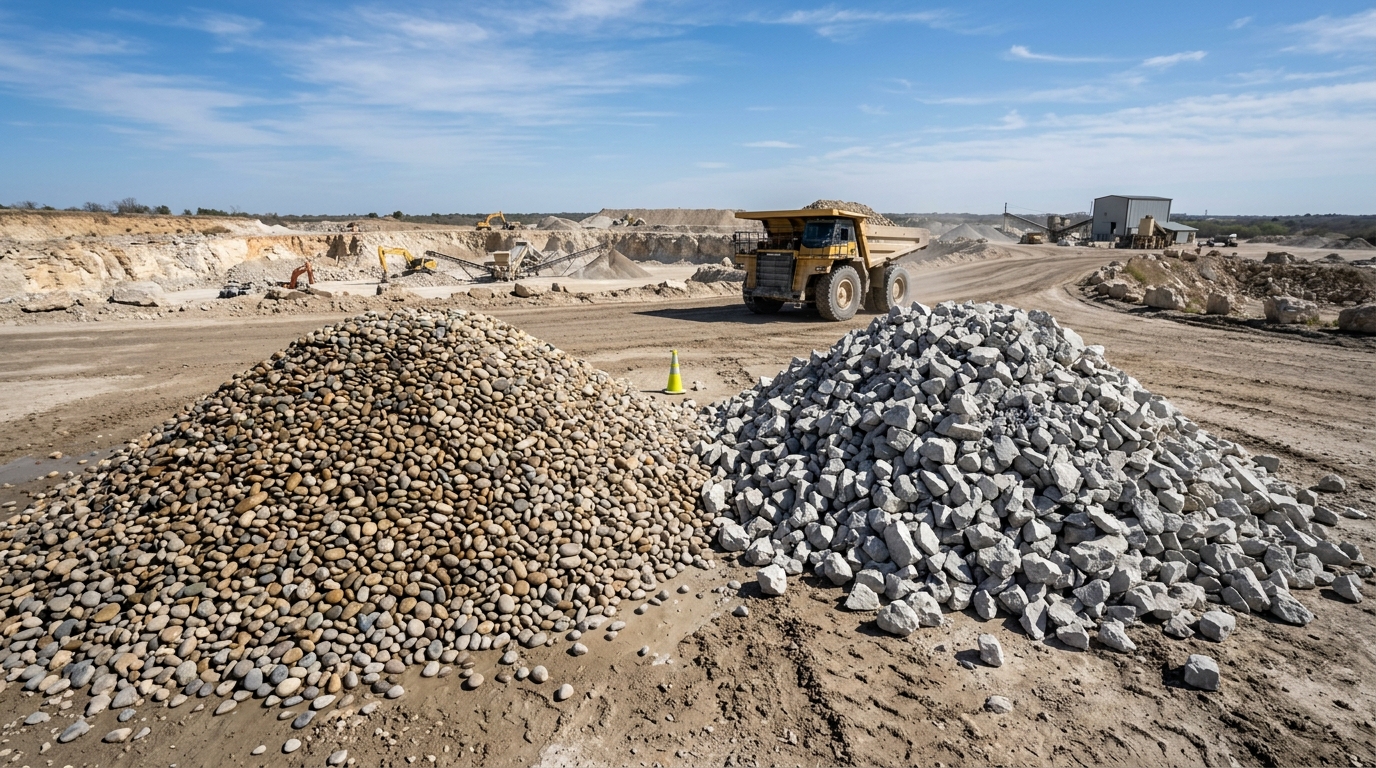
Pit gravel consists of naturally weathered, smooth, rounded stone deposits excavated from riverbeds, floodplains, and glacial deposits. Over thousands of years, natural water movement smoothed its sharp edges, producing rounded pebbles and smooth river rock.
Crushed stone is mechanically quarried rock, typically limestone, granite, or basalt, fractured by heavy industrial crushers. This mechanical crushing yields sharp, angular particles with rough surface textures and jagged edges.
Evaluating both materials in laboratory testing highlights key compaction differences. Angular crushed stone particles interlock tightly under roller vibration, forming a stable, rigid sub-base. Rounded pit gravel particles roll past one another, providing superior water drainage but lower mechanical interlock under heavy wheel loads.
Gradation Differences and Typical Applications
Aggregates undergo mechanical screening to establish consistent particle size distribution across various civil engineering applications:
Applications for Pit Gravel
Because rounded gravel allows free water flow without clogging filter fabric, contractors prefer pit gravel for French drains, pipe bedding, septic drain fields, and decorative driveways across Houston and Gulf Coast projects where drainage is a priority.
Applications for Crushed Stone
Engineers specify crushed stone for heavy-load applications, including asphalt sub-base, concrete aggregate mix, railroad ballast, and industrial crane pads across Dallas commercial builds. When evaluating materials for heavy haul roads, crushed stone resists shifting under high truck traffic.
When Engineers Specify Pit Gravel or Crushed Rock
Public works specifications enforced by the Texas Department of Transportation dictate aggregate selection based on structural load requirements:
- Structural Road Base (Item 247): Requires 100 percent crushed angular stone (flexbase) to guarantee particle interlock and CBR load strength.
- Drainage Structures: Prefers washed pit gravel or #57 crushed limestone where maximum water flow is required without clogging pipe perforations.
- Temporary Access Roads: Permits un-crushed pit-run gravel as an economical temporary base over soft clay subgrades during early site prep operations.
Engineers check Sieve Analysis (ASTM C136) lab reports before approving aggregate submittals for site construction.
Cost and Availability Across Texas and Southeast Markets
Aggregate pricing depends heavily on quarry proximity and transportation distance from the pit face to the job site:
- Central and North Texas: Abundant limestone quarries yield lower prices for crushed stone ($18 to $28 per ton delivered).
- Gulf Coast and East Texas: River pit deposits make un-crushed pit gravel more affordable ($14 to $22 per ton), while crushed rock requires rail import.
Comparing pit gravel vs crushed stone costs requires factoring in hauling distance from local pits to the job site to calculate true delivered ton pricing.
Sourcing Quality Aggregates for Texas Projects
Securing bulk rock for commercial sites requires reliable supply logistics and verified quarry data. Earthwork managers can compare pit gravel vs crushed stone options through a dedicated construction material marketplace Texas platform like BorrowPit. Using digital platforms lets contractors BorrowPit to search listings near them for nearby quarries or list their excess material to connect directly with regional buyers.
Conclusion
Deciding between pit gravel vs crushed stone depends on your project’s specific load requirements and drainage needs. While rounded pit gravel offers excellent water permeability for drainage systems, angular crushed stone provides the structural interlock necessary for heavy paving sub-bases. Sourcing aggregates through BorrowPit ensures contractors find verified local suppliers to keep site operations moving efficiently and cost-effectively across Texas.
Frequently Asked Questions
Which aggregate is better for a gravel driveway?
Crushed stone compacts better and stays in place under car tires due to its angular interlock. Rounded pit gravel tends to shift under vehicle weight unless contained by structural borders.
Why is crushed stone preferred for concrete mixing?
Sharp angular crushed rock bonds tighter with cement paste, providing higher tensile and compressive strength than smooth rounded gravel.
Does pit gravel drain better than crushed stone?
Yes, rounded gravel particles create consistent internal air voids that allow water to flow freely, making it ideal for French drains and septic fields.
What is flexbase aggregate?
Flexbase is a crushed stone mixture containing angular crushed rock and stone dust, engineered to compact into a dense road base under TxDOT Item 247.
How do contractors estimate required aggregate tonnage?
Multiply volume in cubic yards by 1.4 tons per yard for crushed stone or 1.35 tons per yard for gravel to determine total delivery weight for the job.