Whether you’re preparing a commercial building pad in Houston, grading a residential subdivision in Dallas-Fort Worth, or constructing roadway embankments near Austin, choosing the correct fill material is one of the most important decisions on an earthwork project. Yet terms like select fill, structural fill, and common fill are often used interchangeably, even though they can represent very different materials with different engineering requirements.
Understanding select fill vs structural fill vs common fill is essential for contractors, estimators, developers, and project managers. Using the wrong material can lead to failed density tests, rejected inspections, additional stabilization work, and costly schedule delays. More importantly, these materials are not defined by one universal standard. Their requirements often vary depending on the geotechnical engineer, municipality, or agency such as the Texas Department of Transportation (TxDOT), making it critical to review project specifications before procurement begins.
Understanding the Different Types of Fill Material
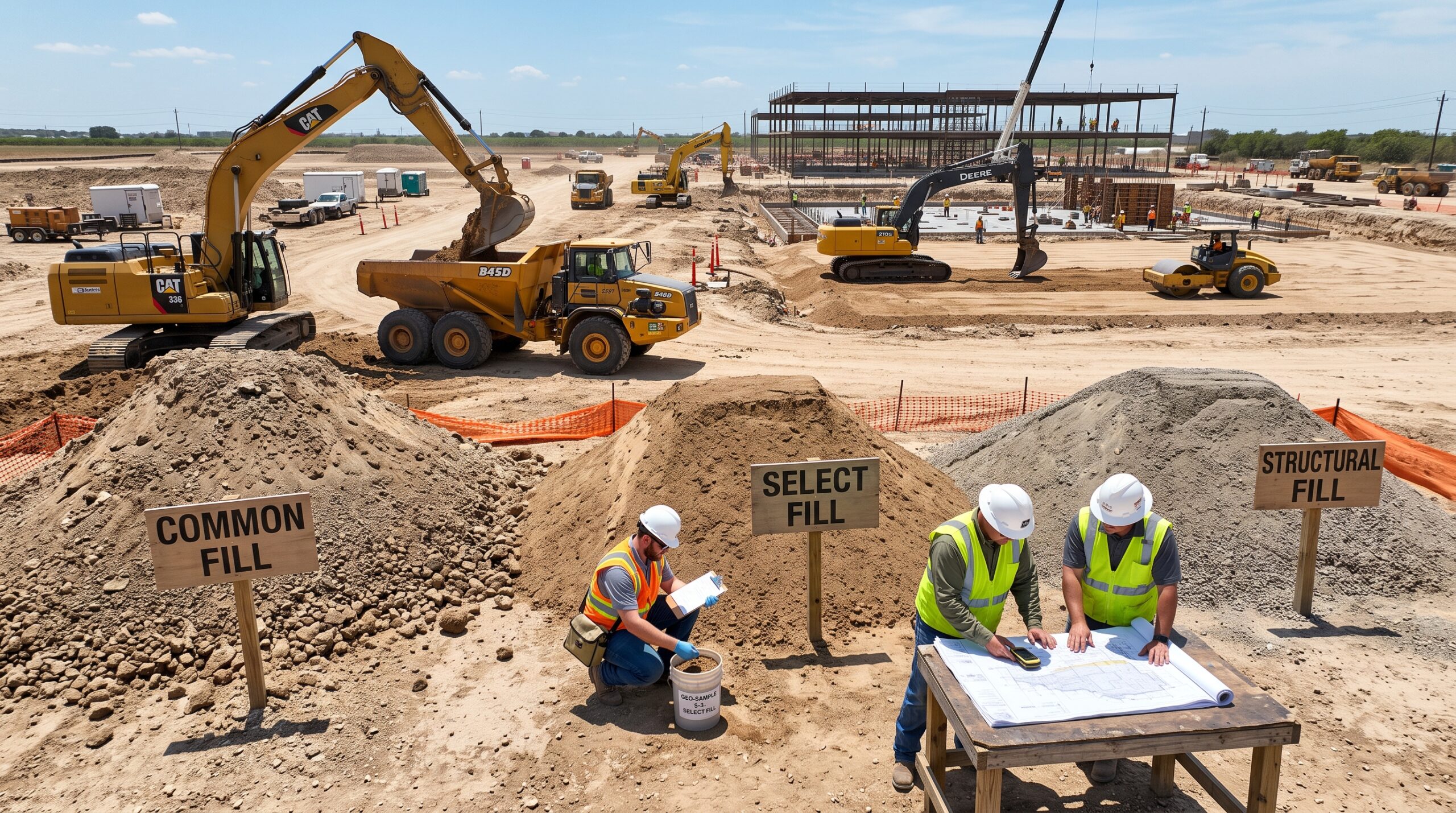
Although these materials may look similar in a stockpile or borrow pit, they serve different purposes on a construction project. Knowing where each is appropriate helps avoid unnecessary costs and ensures the material meets engineering expectations.
What Is Common Fill?
Common fill is the most widely available earthwork material and is generally used where structural performance is not the primary concern. It often consists of naturally occurring soils excavated from borrow pits or construction sites and may include clay, sandy clay, silty soils, or blended native materials.
Because common fill is intended for bulk earthmoving rather than structural support, it usually has fewer engineering requirements. Contractors commonly use it for mass grading, raising site elevations, backfilling large open areas, berm construction, and balancing cut-and-fill operations across a project.
For example, a master-planned community in North Texas may require more than 100,000 cubic yards of common fill simply to establish finished grades before utilities and roads are installed. While the material must still be free from debris, organics, and unsuitable waste, it typically does not require the same level of laboratory testing as structural applications unless specified by the project engineer.
What Is Select Fill?
Unlike common fill, select fill is chosen because it possesses specific engineering characteristics. The name “select” does not refer to a particular soil type, it simply means the material has been selected to satisfy project-specific geotechnical requirements.
This is why select fill means different things to different people. One geotechnical engineer may define select fill as a low-plasticity clay meeting specified Atterberg Limits, while another may require a sandy material with strict gradation and moisture-density characteristics. Municipal standards, private developments, and TxDOT projects may all define select fill differently.
Select fill is commonly specified for:
- Building pads
- Utility trench backfill
- Structural embankments
- Retaining wall backfill
- Pavement subgrades
- Areas requiring predictable compaction
Before approval, select fill often undergoes laboratory testing to verify properties such as Plasticity Index (PI), moisture-density relationship (Proctor), gradation, and soil classification. Contractors should never assume that material marketed as “select fill” automatically meets a project’s specifications without reviewing the engineer’s requirements.
What Is Structural Fill?
Structural fill is any engineered material approved to support structural loads safely over the life of the project. Unlike common fill, structural fill is defined more by performance than by the soil itself.
Structural fill may consist of approved select fill, crushed aggregate, processed borrow material, or other engineered materials capable of achieving specified density and stability. It is commonly used beneath foundations, bridge approaches, retaining structures, roadway embankments, and heavily loaded pavements where settlement must be minimized.
Because structural fill directly affects long-term performance, geotechnical engineers typically require extensive testing before placement. Field inspectors also monitor moisture conditioning, lift thickness, and compaction throughout construction to ensure the material consistently achieves the required density.
On large industrial developments in Houston or warehouse projects along Interstate 35 near San Antonio, structural fill often represents one of the most closely inspected components of site preparation.
When Each Fill Material Is Used on a Project
Selecting the appropriate fill depends on the intended application rather than simply material availability. Project specifications determine whether common fill is sufficient or if engineered materials are required.
The following examples illustrate where each category is most commonly used.
Common Fill for Bulk Earthmoving
Common fill is generally the most economical option for large-scale grading operations where structural loading is minimal.
Typical applications include:
- Site balancing
- Landscape berms
- Detention ponds
- General grading
- Non-structural backfill
- Raising site elevations
Residential developments around Frisco, McKinney, and Denton frequently use common fill during initial grading before higher-quality materials are imported for building pads and roadways.
Select Fill for Controlled Construction Areas
Select fill becomes necessary where engineers require greater consistency and predictable performance.
Typical applications include:
- Residential building pads
- Commercial foundations
- Utility corridors
- Roadway subgrades
- Pavement support layers
- Engineered embankments
Although select fill generally costs more than common fill, using the correct material reduces the likelihood of failed compaction tests, excessive settlement, and expensive corrective work later in the project.
Structural Fill for Load-Bearing Applications
Structural fill is specified wherever the completed structure depends on the performance of the underlying soil.
Common structural applications include:
- Bridge approaches
- Mechanically stabilized earth (MSE) walls
- Heavy industrial facilities
- Warehouse foundations
- Highway embankments
- Structural retaining walls
Because failures in these areas can result in significant repair costs, contractors should expect ongoing quality assurance testing throughout construction rather than relying solely on initial laboratory approval.
Why Specifications Vary Between Engineers and Agencies
One of the biggest misconceptions in earthwork construction is assuming these material names have universal definitions. In reality, project specifications determine what qualifies as acceptable fill.
Before ordering material, contractors should review the project’s geotechnical report, construction specifications, and any agency requirements.
Private Developments vs TxDOT Projects
A commercial development in Dallas may allow locally sourced select fill that satisfies the geotechnical engineer’s recommendations, while a TxDOT highway project may require imported borrow material meeting specific specification items and quality standards.
Similarly, one municipality may permit higher Plasticity Index values than another, depending on local soil conditions and intended use. This is why a borrow source approved for one project cannot automatically be assumed acceptable on another.
Contractors working on public infrastructure projects can review applicable earthwork specifications through the official TxDOT Standard Specifications website.
Understanding these requirements before procurement helps avoid rejected materials, hauling delays, and unnecessary project costs.
Sourcing the Right Fill Material in Texas
Finding available material is only part of the procurement process. Contractors must also verify that suppliers can provide the required quantities, maintain consistent quality, and supply supporting laboratory documentation when necessary.
Before selecting a supplier, project teams typically evaluate:
- Material availability
- Laboratory testing reports
- Production capacity
- Hauling distance
- Delivery schedules
- Previous project experience
Rather than relying solely on local contacts, many contractors now use digital marketplaces to compare suppliers across multiple regions. BorrowPit helps contractors connect with Texas suppliers offering common fill, select fill, structural fill, and other bulk earthwork materials. Companies can browse available dirt listings through the marketplace, learn more about the platform on the About Us page, or contact the team directly for project-specific sourcing assistance.
If you’re searching for qualified suppliers, search listings near you on BorrowPit to compare available materials throughout Texas. Material owners can also list their material on BorrowPit to connect directly with contractors, developers, and project managers looking for bulk fill across the state.
Conclusion
Understanding select fill vs structural fill vs common fill is essential for successful earthwork planning. While common fill is suitable for general grading, select fill is chosen to meet specific engineering criteria, and structural fill is approved to support critical loads where long-term performance matters most.
Because these terms are defined by project specifications rather than universal standards, contractors should always verify geotechnical requirements before sourcing material. Whether you’re developing a subdivision in Dallas-Fort Worth, constructing an industrial facility in Houston, or building roadway infrastructure in Austin or San Antonio, selecting the right fill material helps reduce inspection failures, protect project schedules, and control construction costs.
FAQs
What is the difference between select fill and common fill?
Common fill is used for general grading and non-structural applications, while select fill is chosen because it meets specific engineering and geotechnical requirements for controlled construction areas.
Is structural fill the same as select fill?
Not always. Structural fill describes material approved to support structural loads, while select fill refers to material selected to meet project specifications. In many projects, select fill may also serve as structural fill if it satisfies engineering requirements.
Who determines which fill material can be used?
The project’s geotechnical engineer, owner, municipality, or agency such as TxDOT establishes the acceptable fill requirements through the project specifications.
Can common fill be used beneath building pads?
Generally, no. Most building pads require engineered or select fill that has been tested and approved to meet compaction and performance requirements.
Where can contractors find select fill and structural fill in Texas?
Contractors can source bulk fill materials through qualified borrow pits, aggregate suppliers, and online marketplaces such as BorrowPit, where suppliers advertise available material throughout Texas.