Selecting fill material isn’t simply about finding available dirt. For Texas contractors working on subdivisions, commercial developments, roadway embankments, or industrial sites, the plasticity index for construction fill is one of the most important engineering properties affecting long-term performance. A borrow pit may produce material that appears suitable, but if laboratory testing reveals an unsuitable Plasticity Index (PI), the soil may be rejected before placement or require expensive stabilization.
Whether you’re constructing a residential development in Dallas-Fort Worth, a highway expansion near San Antonio, or a commercial site in Houston, understanding how Plasticity Index influences material selection helps reduce failed inspections, avoid costly rework, and improve project schedules. Because many municipalities, geotechnical engineers, and agencies such as TxDOT establish acceptable PI ranges, contractors should evaluate laboratory reports before committing to a material source.
Understanding Plasticity Index for Construction Fill
Plasticity Index (PI) is a geotechnical property used to measure how much a fine-grained soil can change shape with moisture without cracking or flowing. In practical terms, it indicates how susceptible a soil is to shrinking during dry conditions and expanding when it absorbs water.
For construction projects, PI helps engineers determine whether a soil can provide a stable foundation beneath building pads, roadways, parking lots, utility trenches, or embankments. Soils with excessive plasticity often experience greater movement as moisture conditions change, increasing the risk of pavement cracking, differential settlement, and structural damage.
PI is not determined through a visual inspection. Instead, it is calculated through laboratory testing using Atterberg Limits in accordance with ASTM D4318, the industry standard for determining the Liquid Limit, Plastic Limit, and Plasticity Index of soils.
Contractors sourcing engineered fill throughout Texas should request laboratory reports before purchasing large quantities of material rather than relying solely on supplier descriptions or previous project experience.
For official testing standards and engineering guidance, contractors can reference ASTM International.
How Plasticity Index Is Tested
Before discussing acceptable PI values, it helps to understand how laboratories determine them. The Plasticity Index is calculated using two measurements obtained through the Atterberg Limits test.
Atterberg Limits and ASTM D4318
Atterberg Limits classify the moisture behavior of fine-grained soils. Testing performed under ASTM D4318 measures:
- Liquid Limit (LL): The moisture content at which soil changes from a plastic state to a liquid state.
- Plastic Limit (PL): The moisture content at which soil changes from a semi-solid state to a plastic state.
- Plasticity Index (PI): Calculated as PI = Liquid Limit − Plastic Limit.
For example:
| Test Result | Value |
| Liquid Limit | 42 |
| Plastic Limit | 24 |
| Plasticity Index | 18 |
A higher PI indicates a greater range over which the soil remains plastic, often corresponding to increased clay content and higher shrink-swell potential.
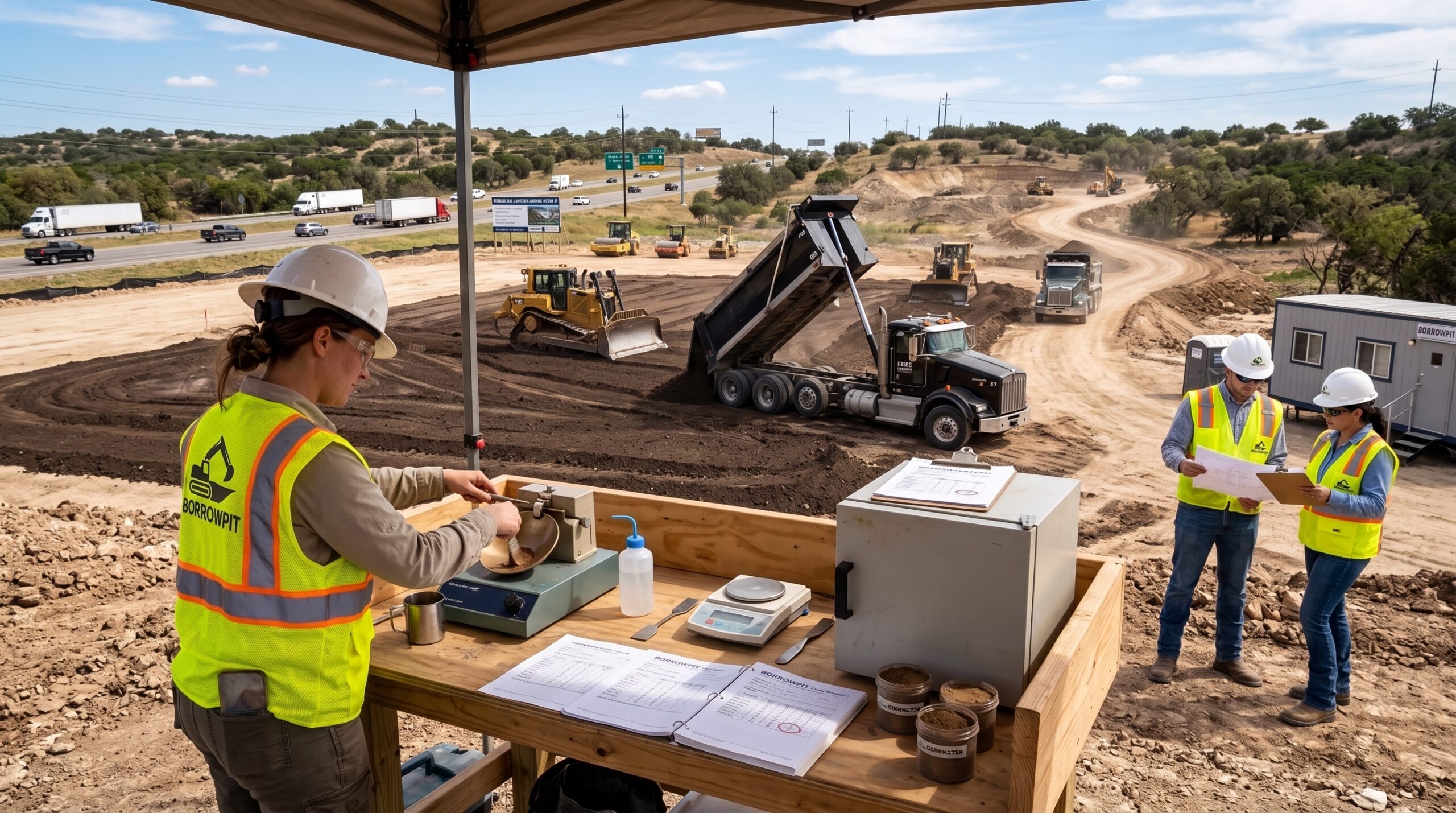
Testing is typically completed on representative samples collected from borrow pits or excavation sites before material is approved for construction. For larger projects, engineers may require multiple samples across different areas of the borrow source to verify consistency.
Low PI vs High PI: What It Means for Construction
Plasticity Index values directly influence how fill material behaves once placed and compacted. While acceptable ranges vary by project and specification, understanding the practical differences helps contractors evaluate material suitability.
Low PI vs High PI Soils
Generally, soils with a low Plasticity Index are more dimensionally stable. They undergo less expansion when wet and less shrinkage when dry, making them suitable for many engineered applications where long-term stability is important.
By contrast, high PI soils contain more active clay minerals and are more likely to experience significant volume changes as moisture conditions fluctuate. This movement can affect pavement performance, building foundations, retaining structures, and utility installations.
Common concerns associated with high PI soils include:
- Excessive shrink-swell movement
- Pavement cracking
- Differential settlement
- Difficulty maintaining optimum moisture during compaction
- Increased stabilization costs
North and Central Texas present particular challenges because expansive clay soils associated with the Blackland Prairie often exhibit higher Plasticity Index values than sandy soils found in other parts of the state. As a result, geotechnical engineers frequently recommend select borrow sources or stabilization methods before construction begins.
Why Municipalities and TxDOT Specify Plasticity Index Ranges
Not every project requires the same Plasticity Index. Acceptable values depend on how the material will be used and which agency governs the work.
Public infrastructure projects commonly reference specifications established by the Texas Department of Transportation (TxDOT), while private developments typically follow recommendations prepared by the project’s geotechnical engineer.
Before approving fill material, engineers evaluate whether the Plasticity Index is appropriate for the intended application, considering factors such as soil classification, compaction characteristics, drainage conditions, and expected loading.
Projects involving roadway embankments, bridge approaches, and structural fills often include specific limits on PI because excessive soil movement can reduce pavement life and increase long-term maintenance costs.
Current TxDOT material specifications can be reviewed through the official Standard Specifications webpage.
Although contractors often ask for a single “acceptable PI,” there is no universal value that applies to every project. Requirements vary depending on contract documents, local agency standards, and engineering design.
Practical Guidance for Contractors Sourcing Fill Material
Understanding the plasticity index for construction fill is only valuable if it influences purchasing decisions. Contractors can reduce risk by reviewing engineering documentation before material is hauled to the jobsite.
Rather than selecting a supplier based solely on price or proximity, project teams should verify:
- Recent laboratory testing performed on representative samples
- Plasticity Index and Atterberg Limits reports
- Gradation and soil classification data
- Borrow source consistency
- Material availability throughout the project duration
- Hauling distance and production capacity
For example, a supplier located near Austin may offer competitive pricing, but if testing indicates a PI outside the project’s allowable range, stabilization or replacement costs can quickly outweigh any savings.
Many contractors now use digital marketplaces to compare multiple suppliers before procurement begins. BorrowPit helps contractors, developers, and earthwork professionals locate fill material suppliers across Texas, making it easier to identify borrow sources closer to the jobsite and reduce hauling costs. Contractors can browse available fill material through the BorrowPit Dirt Marketplace, while those wanting to learn more about the company’s sourcing solutions and brokerage services can visit the About Us page. For project-specific assistance locating compliant fill material or discussing supplier options, the BorrowPit team can be contacted directly through the Contact Us page.
Conclusion
Understanding the plasticity index for construction fill helps contractors make informed sourcing decisions before earthwork begins. Since PI directly affects shrink-swell behavior, compaction performance, and long-term stability, it remains one of the most closely reviewed properties during geotechnical evaluations. By reviewing Atterberg Limits testing, confirming compliance with project specifications, and selecting qualified suppliers early, contractors can reduce the risk of rejected material, construction delays, and costly corrective work. For projects across Houston, Dallas-Fort Worth, Austin, San Antonio, and the rest of Texas, evaluating Plasticity Index before procurement is a practical investment that supports both project quality and schedule.
FAQs
What is Plasticity Index in soil testing?
Plasticity Index (PI) measures the range of moisture over which a soil remains plastic. It is calculated by subtracting the Plastic Limit from the Liquid Limit using Atterberg Limits testing under ASTM D4318.
Why is Plasticity Index important for construction fill?
PI helps engineers evaluate a soil’s shrink-swell potential, workability, and long-term stability. Materials with unsuitable PI values may fail to meet project specifications or require stabilization.
Does TxDOT specify Plasticity Index requirements?
Yes. Many TxDOT specifications include Plasticity Index requirements depending on the material type and application. Contractors should always review the project specifications for applicable limits.
Can high PI soil still be used on construction projects?
In some cases, yes. High PI soils may be acceptable for certain applications or may be stabilized with lime or other additives if permitted by the project specifications and approved by the engineer.
How can contractors find tested fill material in Texas?
Contractors can work with qualified suppliers that provide laboratory testing reports or use platforms like BorrowPit to identify potential fill material sources throughout Texas before procurement.