Any person handling a big business building in Texas understands how fast a project can stall out due to material issues. When the wrong fill material arrives at the site, schedules suffer, trucking expenses rise, and retaining wall work is a burden. That is particularly the case when it comes to quality MSE backfill in Texas, as performance goes well beyond just dirt delivery.
Whether the structure is a shopping center in Frisco, Texas, a warehouse in the San Antonio region, or an industrial facility near the Port of Houston, MSE backfill isn’t just another line item in procurement. It is also directly linked to issues with wall stability, drainage, and long-term settlement and approval for inspection.
The problem is that many contractors still look for engineered fill as they would look for regular dirt. Call around, check a handful of local aggregate quarries, and hope it is correct upon arrival. On large-scale commercial building sites, that’s a risky strategy.
Why Commercial Projects Can’t Treat MSE Backfill Like Regular Fill Dirt
The disposal of general site dirt is pretty different from sourcing engineered backfill for a reinforced earth system.
The material performance standards of large retaining walls associated with commercial developments are very specific. If the compaction and drainage specifications are not met, then all of the backfill is at risk over time.
The Material Has to Work With the Wall System
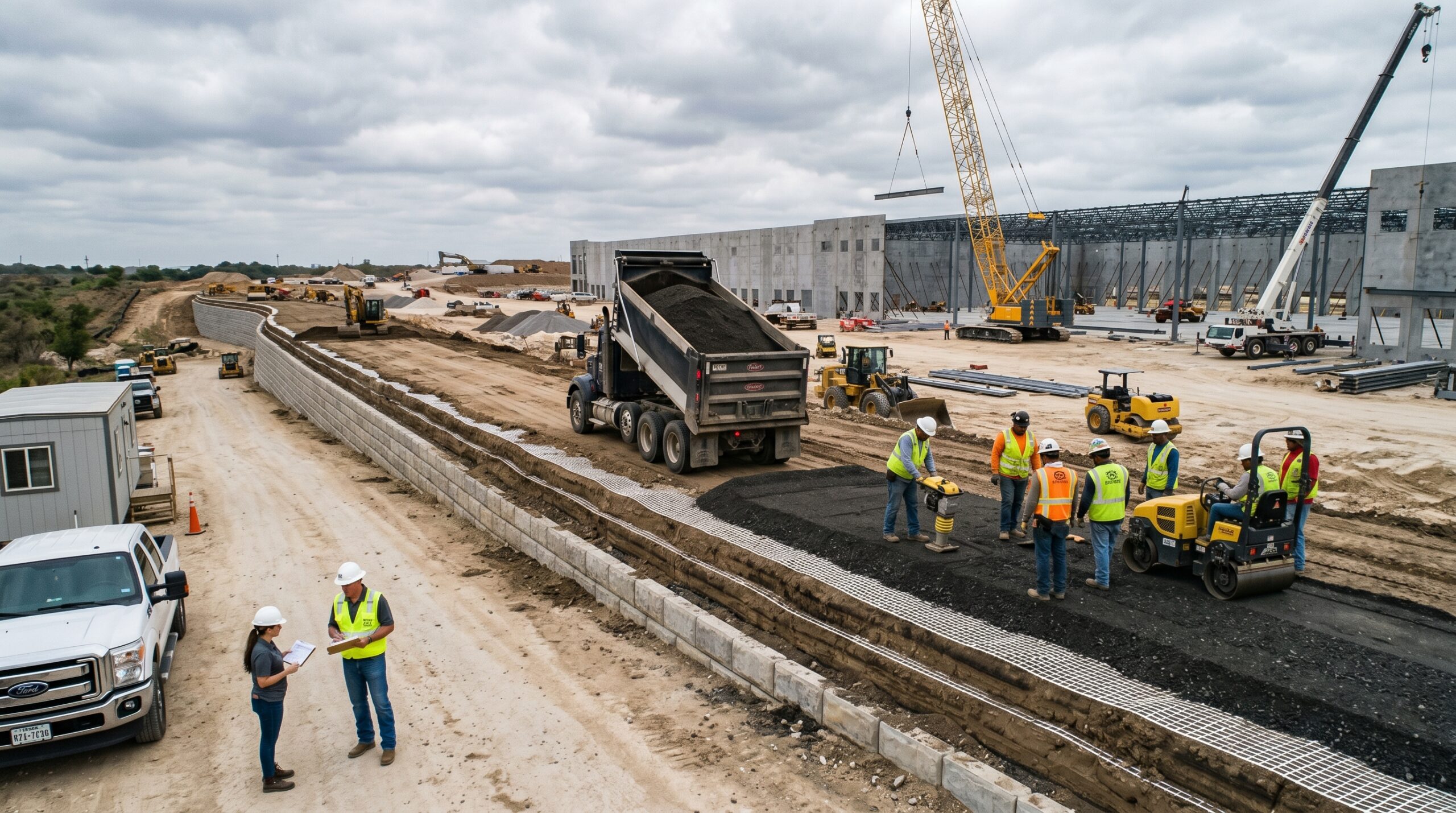
The most common mechanically stabilized earth walls use geogrids or layers of reinforcement put into a mechanically compacted soil. The fill material has to “lock in” properly with those systems.
This is why contractors that aim to hire quality MSE backfill in Texas tend to seek:
- Granular structure
- Consistent gradation
- Low plasticity
- Reliable drainage performance
- Strong compaction characteristics
Most of the time, clay-prone excavation waste is disqualified.
A recent retail expansion near SH 121 in North Texas was reported to have had to reject several truckloads due to moisture inconsistencies not acceptable to the Engineer of the retaining wall. Such a problem can quickly put schedules on hold.
The Federal Highway Administration (FHWA) has imposed rigorous performance standards on reinforced soil structures since inadequate backfill material is one of the most frequent reasons for long-term failure.
Drainage Problems Usually Start With Material Choice
Retaining walls fail, not just overnight, in Texas. In most cases, water makes its way into the scene somehow.
Where the backfill does not drain, the hydrostatic pressure forms against the wall. That pressure over time degrades stability and makes it more likely to move.
That is why an established contractor will keep drainage performance as a major consideration in choosing the engineered backfill materials for Texas projects rather than just the cost per ton.
Where Contractors Actually Find Reliable MSE Backfill Suppliers in Texas
One of the largest misconceptions is that all aggregate yards have the right kind of MSE material. Many don’t.
Business contractors normally obtain from:
- Engineered fill suppliers
- Large aggregate producers
- Highway material providers
- Specialized structural fill operations
The issue is visibility. It is not always easy to locate material near an “operating” project.
Local Availability Changes Everything
Project economics can change drastically based on hauling distance. For instance, a commercial retaining wall project, which is attempted from 15 miles away, is certainly not the same as obtaining the same fill from a location 70 miles away, where trucking expenses begin to add up.
That is why a lot of contractors concentrate on regional sourcing strategies nearby:
- Dallas–Fort Worth distribution corridors
- Houston industrial development zones
- I-35 commercial expansion routes
- Port-adjacent construction areas
The closer the source, the easier it will be to manage the timing of delivery and trucking coordination.
Digital Sourcing Is Replacing Old-School Material Hunting
Platforms such as BorrowPit now exist to meet the needs of contractors finding related resources more quickly, and to help suppliers identify the amount of material that is currently being used for commercial purposes. Some contractors also directly utilize the platform for assistance in brokering quotes and sourcing coordination when they require quotes. Others post what they have to offer and put buyers and sellers in contact.
BorrowPit explains more about its marketplace and sourcing model on its About page.
This flexibility becomes very pertinent in large commercial projects that change constantly in terms of timeliness, and materials are required on a weekly basis.
What Contractors Look for Before Ordering Engineered Fill
You probably won’t find any experienced project managers who ask for their price first. They typically seek answers to questions that impact the jobsite in real time.
Can the Supplier Handle Volume Consistently?
Structural fill for a retaining wall to enclose a warehouse might involve a phased delivery of thousands of tons. Partial loads and irregular trucking schedules result in wasted labor hours spent waiting for the load, if the supplier cannot accommodate this.
This is particularly significant for fast-moving works in the vicinity of:
- AllianceTexas developments in Fort Worth
- Industrial parks along Beltway 8 in Houston
- Commercial corridors near I-10 and Katy
Reliable delivery is also as important as the material quality itself.
Does the Material Meet Engineering Requirements?
Testing documentation may be needed for commercial projects prior to being approved. Texas engineer specifications for mechanically stabilized earth backfill may include the following requests by contractors:
- Gradation reports
- Moisture-density testing
- Plasticity index data
- Compaction performance information
Material approvals without documentation can become a bottleneck. The Texas Department of Transportation also has requirements for structural fill systems and reinforced soil systems for infrastructure projects.
Why More Commercial Contractors Are Using Material Brokers
Sourcing has become more complicated, and for that reason, brokering has become increasingly popular. This great speed of delivery has caused large projects today to grow so fast that contractors find they need material solutions within moments rather than days of manual searching.
Brokers Help Match Supply With Active Demand
In some situations, the materials excavated from one site are suitable for reuse at another nearby location that requires engineered fill. A broker helps fill that void more quickly.
With local coordination, contractors can minimize waste from transportation as alternative materials are used instead of being wasted and transported from far away.
This is becoming increasingly common across:
- Mixed-use developments in Dallas
- Logistics hubs near Houston
- Highway-adjacent commercial expansion zones
Advertising vs Direct Brokering
There are some suppliers who like to have their materials openly available on the internet, for the contractors to reach them directly. Some people like a more hands-on brokering, where sourcing coordination occurs directly.
BorrowPit advocates for both approaches:
- Direct brokering assistance
- Listing-based advertising for suppliers and contractors
Contractors can reach out via the contact page for ongoing project coordination or sourcing discussions.
The Real Cost of Cheap Backfill
Many contractors must find out the hard way.
A low-cost fill can cost a lot of money if:
- Trucks get rejected on-site
- Compaction fails
- Drainage problems appear
- Crews sit idle waiting for replacement loads
On commercial projects, time is the second most expensive component after the materials. Quality sourcing of MSE backfill in Texas is therefore not about choosing the lowest cost material, but avoiding downstream project issues.
Good material keeps:
- inspections moving
- schedules predictable
- Retaining wall crews are productive
- trucking operations efficient
Final Thoughts
Finding a good quality MSE backfill in Texas for large commercial projects is not as easy as calling up a dirt supplier. Contractors require an engineered material that can facilitate drainage, compaction, reinforcement systems, and long-term retaining wall stability.
With the pace of commercial development in Dallas–Fort Worth, Houston, Austin, and San Antonio growing at a rapid rate, smarter sourcing strategies are gaining in importance just as much as engineering design.
To improve sourcing visibility, contractors can use search listings near you to browse sourcing materials or post their materials to connect with commercial buyers searching and suppliers who are looking to connect across Texas.
FAQs
What is MSE backfill used for?
MSE backfill should be applied behind the retaining wall and reinforced soil system for stability and drainage.
Why is engineered backfill important on commercial projects?
Structural, drainage, and compaction requirements for long-term performance of retaining walls using engineered fill.
Can regular excavation dirt be used as MSE backfill?
Usually not. For most projects, it is necessary to have the granular engineered material with certain geotechnical characteristics.
How do contractors source MSE backfill in Texas?
The trend is for sourcing via the aggregate supplier, engineered fill provider, broker, or digital construction marketplace.
What affects MSE backfill pricing the most?
The price is affected by transportation distance, truck availability, material quality, and volume of projects.