Earthwork contractors, site developers, and civil engineers working across the Gulf Coast frequently encounter sticky, heavy soils known locally as gumbo clay. Whether grading job sites in East Texas, excavating trenches near Houston, or handling mass cut-and-fill operations in southern Louisiana, understanding the unique behavior of gumbo clay in construction is necessary for avoiding structural foundation failures.
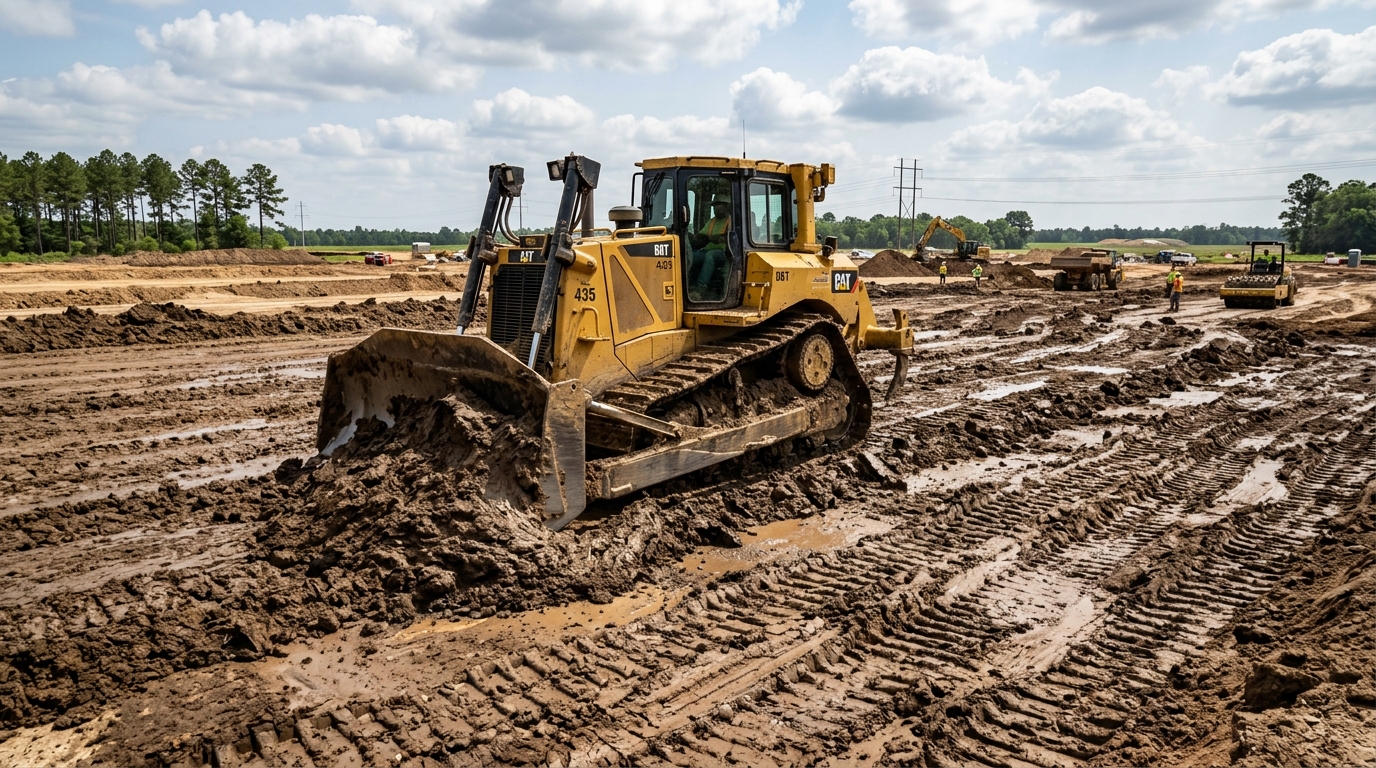
Gumbo clay is notorious for changing dramatically when wet. It transforms from a hard, cracked crust in dry weather into a slick, heavy mass that sticks to excavator buckets and bulldozer tracks. While this soil type poses major engineering hurdles, understanding how gumbo clay functions under different moisture conditions helps contractors make informed decisions during site prep and soil stabilization.
Defining Gumbo Clay: CH Soil Classification Under USCS and ASTM D2487
To evaluate gumbo clay in construction, geotechnical engineers rely on standard laboratory soil testing. Under the Unified Soil Classification System (USCS) per ASTM D2487, gumbo clay is classified as a CH soil classification. The letter C stands for clay, while H designates high plasticity, indicating a liquid limit of 50 or greater.
This high-plasticity designation means the soil consists of ultra-fine clay minerals, primarily montmorillonite or smectite. These microscopic platelets hold significant amounts of water between their mineral layers. As a result, gumbo clay displays high stickiness, high compressibility, and extremely low water permeability when fully compacted.
High Plasticity Index and Liquid Limit Characteristics
Engineers run Atterberg Limits tests (ASTM D4318) to determine soil consistency. Gumbo clay typically exhibits:
- Liquid Limit (LL): Greater than 50, often reaching 65 to 90 in coastal floodplains.
- Plasticity Index (PI): Ranging from 30 to over 50, placing it well above standard select fill limits.
- Fine Particles: Over 50 percent of the soil mass passes through a No. 200 sieve (0.075 mm).
These numerical values explain why managing gumbo clay in construction projects requires careful planning. High PI soils absorb moisture readily and retain it for long periods, preventing quick drying during earthwork operations.
Regional Deposits: Where Gumbo Clay Is Commonly Found
Gumbo clay formed over thousands of years as fine river sediments settled across low-lying coastal plains and river valleys. Contractors routinely deal with gumbo clay across specific geographic corridors:
- Texas Gulf Coast and Houston Metro: Found extensively across Harris, Fort Bend, Brazoria, and Jefferson counties, where alluvial river deposits created deep clay layers.
- East Texas Piney Woods: Prevalent in flat river basins and bottomlands surrounding the Trinity, Neches, and Sabine rivers.
- Southern Louisiana: Widespread across alluvial plains, bayous, and coastal parishes from Lake Charles to New Orleans.
Due to heavy rainfall and flat terrain in these regions, earthwork crews often struggle with saturated soil conditions when excavating gumbo clay in construction job sites.
Geotechnical Challenges: Shrink-Swell Potential and Compaction Issues
Placing un-treated CH soil directly beneath structures introduces significant long-term risks. Understanding the primary challenges of gumbo clay in construction allows project managers to prevent costly pavement cracking and foundation movement.
Severe Shrink-Swell Cycles
The most destructive characteristic of CH clay is volumetric expansion. When rain falls, the clay minerals absorb water and expand by 10 percent or more, exerting massive upward pressure on slab foundations, concrete flatwork, and underground utility pipes. Conversely, during dry summers, the soil loses moisture, shrinks, and forms deep surface cracks. This continuous soil movement leads to cracked building walls and buckled roadways.
Compaction and Moisture Sensitivity
Achieving proper compaction with heavy clay demands precise field control. When wet, the soil becomes spongy, causing heavy rollers to sink and weave without achieving target density. If compacted when too dry, the soil breaks into hard, cloddy chunks that leave internal air voids. Once water enters those voids later, the fill softens and settles.
When Gumbo Clay Is Acceptable and When It Must Be Rejected
Project specifications govern whether contractors can reuse excavated site soil or if it must be hauled away. Knowing when gumbo clay in construction meets engineering approval helps avoid job-site rejections.
Unacceptable Uses for Gumbo Clay
Geotechnical specifications strictly prohibit un-treated CH gumbo clay in structural applications:
- Building Pad Select Fill: Standard building specifications limit PI to between 7 and 20. Raw gumbo clay exceeds this range and will cause foundation heaving.
- Utility Trench Backfill: Using raw CH clay around utility pipes leads to settlement as the clay shrinks, eventually exposing pipes to stress.
- Bridge Abutments and Retaining Walls: High lateral pressures from expanding clay can tilt or crack retaining wall structures.
Acceptable Applications with Engineering Controls
While raw CH soil is unsuitable for structural foundations, engineers approve gumbo clay in construction for specific non-structural or treated applications:
- Pond Liners and Lagoon Embankments: Because compacted CH soil is nearly impermeable, it forms an excellent natural water seal for storm detention basins and agricultural ponds.
- Deep Embankment Cores: Placed deep within high roadway embankments managed by agencies like the Texas Department of Transportation, provided it is buried below the active moisture zone.
- Lime or Fly Ash Stabilized Subgrade: Treating gumbo clay with 4 to 8 percent hydrated lime chemically alters the clay platelets, reducing the PI to under 15 and transforming it into a stable, workable subgrade layer.
Handling Gumbo Clay on Site and Sourcing Approved Materials
When earthwork reveals heavy CH clay across a job site, project managers must choose between chemical soil stabilization or hauling the material off site. Lime treatment provides a proven solution for subgrade prep, but it adds chemical costs and requires specialized discing equipment.
If chemical stabilization is unfeasible, contractors often undercut the CH soil and haul in certified select fill or sandy loam. Rather than paying expensive landfill fees for excess site cut, developers can list site cut materials or locate local select fill sources through specialized online material platforms.
Contractors searching for tested fill dirt can easily browse available options through a dedicated construction material marketplace Texas platform like BorrowPit. Finding regional pits with verified test reports lets project teams secure approved materials quickly, while site managers with excess cut can connect directly with nearby buyers to reduce hauling expenses.
Conclusion
Successfully managing gumbo clay in construction comes down to respecting its geotechnical limits. While raw CH clay poses serious shrink-swell risks under structural slabs, chemical stabilization or non-structural placement in pond liners allows project teams to utilize site materials effectively. When CH soil must be replaced, contractors can use digital marketplaces like BorrowPit to search listings near them for certified select fill or list their excess material to connect with regional buyers, keeping earthwork projects moving on schedule.
Frequently Asked Questions
What makes gumbo clay different from regular clay?
Gumbo clay is a high-plasticity CH soil with a liquid limit over 50. It absorbs significantly more water, expands more during wet periods, and becomes far stickier than low-plasticity lean clay (CL soil).
Can gumbo clay be used for house foundations?
Raw gumbo clay should never be used as foundation fill under residential slabs due to its high shrink-swell potential. It must be excavated and replaced with low-PI select fill or stabilized with hydrated lime.
How does lime stabilization fix gumbo clay in construction projects?
Hydrated lime reacts chemically with the clay minerals, breaking down their water-absorbing capacity. This chemical reaction lowers the soil Plasticity Index, improves load capacity, and makes the clay easier to compact.
Why is gumbo clay so difficult to compact?
Gumbo clay has a narrow optimum moisture window. If it is slightly too wet, it becomes rubbery and rolls under machinery; if too dry, it forms hard clods that prevent uniform compaction.
Where can contractors sell excess cut gumbo clay in Texas?
Contractors can list excess excavation material on specialized digital platforms like BorrowPit to find buyers needing impermeable fill for pond dikes or deep embankment projects.